

Commerce courses after 10th refer to the Commerce stream in Class 11 and 12 (PUC in Karnataka), covering subjects like Accountancy, Business Studies and Economics, with or without Mathematics depending on the combination chosen. Commerce isn’t limited to accounting; it opens pathways into finance, banking, business management, entrepreneurship and professional courses like CA, CS and CMA after Class 12.
Choosing a stream after Class 10 is one of the first major academic decisions a student makes, and it shapes which doors stay open over the next several years. Commerce, one of the three main streams alongside Science and Arts, deals with how businesses, markets and money work: accounting, economics, finance, management and entrepreneurship all sit under this umbrella. A common misconception is that Commerce means Accountancy and little else. In practice, students who choose the commerce stream after 10th, whether through commerce courses after 10th without maths or a combination that keeps Mathematics, can move toward banking, business management, company law, cost analysis, taxation, or professional qualifications like Chartered Accountancy, depending on which subjects and combination they pick. In Karnataka, this stage is called PUC, Pre-University Course, covering 1st and 2nd PUC, roughly equivalent to Class 11 and 12 elsewhere in India. The subject combination chosen at this stage can influence which degree and professional courses are accessible later, so it’s worth thinking through interests, strengths and rough career direction before deciding, rather than defaulting to whatever a friend picked.
Why Choose Commerce After 10th?
Wide Range of Career Opportunities
Commerce feeds into banking, finance, accounting, taxation, business management, entrepreneurship and government services, among others. Few streams open into this many distinct career directions from a single starting point.
Strong Foundation for Business Studies
Subjects like Business Studies and Economics build an understanding of how organisations and markets actually function, which is useful groundwork whether a student later studies for a business degree or starts something of their own.
Professional Course Opportunities
Commerce is the natural entry point for professional qualifications like Chartered Accountancy, Company Secretary and Cost and Management Accountancy, several of which allow students to begin foundation-level preparation while still in Class 11 or 12. For students aiming to excel in these fields, understanding the Top 5 Competitive Exams in Commerce can provide a clear roadmap for early preparation.
Multiple Higher Education Options
After Class 12 Commerce, students aren’t locked into one degree. B.Com, BBA, BBM, economics honours and integrated professional courses are all realistic next steps, and which one fits best depends on the specific subjects and interests a student has developed.
After 10th Commerce Courses List
The table below gives a practical overview of the main paths available once a student decides on Commerce after Class 10.
| Course / Path | What Students Learn | Future Opportunities |
| PUC / 11th & 12th Commerce (Karnataka) | Accountancy, Business Studies, Economics, plus Mathematics, Statistics or Computer Science depending on combination | B.Com, BBA, CA/CS/CMA, banking, government exams |
| Class 11-12 Commerce (CBSE/ICSE, other states) | Similar core subjects under a national board syllabus | Same as above, useful for students outside Karnataka or planning to study across states |
| Integrated PUC + CA Foundation coaching | Commerce syllabus alongside CA Foundation-level accounting, law and quantitative aptitude | A head start on the Chartered Accountancy path straight after Class 12 |
| Diploma in Financial Accounting (alongside PUC) | Practical accounting software, bookkeeping and real transaction handling | Industry-ready accounting skills alongside the academic PUC course |
| Vocational / skill-based commerce certificates | Tools like Tally, basic GST filing, bookkeeping fundamentals | Entry-level accounts or office-support roles without waiting for a full degree |
Commerce Subjects After 10th
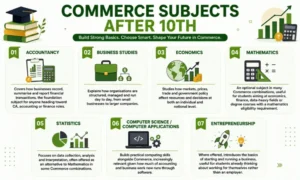
Accountancy
Covers how businesses record, summarise and report financial transactions, the foundation subject for anyone heading toward CA, accounting or finance roles.
Business Studies
Explains how organisations are structured, managed and run day to day, from small businesses to larger companies.
Economics
Studies how markets, prices, trade and government policy affect resources and decisions at both an individual and national level.
Mathematics
An optional subject in many Commerce combinations, useful for students aiming at economics, finance, data-heavy fields or degree courses with a mathematics eligibility requirement.
Statistics
Focuses on data collection, analysis and interpretation, often offered as an alternative to Mathematics in some Commerce combinations.
Computer Science / Computer Applications
Builds practical computing skills alongside Commerce, increasingly relevant given how much of accounting and business work now runs through software.
Entrepreneurship
Where offered, introduces the basics of starting and running a business, useful for students already thinking about working for themselves rather than an employer.
Commerce With Mathematics vs Commerce Without Mathematics
This is one of the most common questions Class 10 students ask, and it’s worth understanding clearly before choosing.
Commerce With Mathematics
This combination may suit students interested in:
- Economics
- Finance
- Banking
- Statistics
- Investment analysis
- Data analysis
- Certain undergraduate programmes with a Mathematics eligibility requirement
Keeping Mathematics can leave some future academic options open that would otherwise need a bridge course, though this depends on the specific eligibility rules of the programme in question.
Commerce Without Mathematics
This path may suit students who:
- Prefer business-related subjects over numerical ones
- Are interested in accounting and management specifically
- Do not want Mathematics as a major subject
- Want to explore business, management, accounting or related fields without a heavy quantitative load
Is Commerce Without Maths a Good Option?
It can be a strong choice depending on a student’s career goals, not a lesser one. Before deciding, it’s worth checking eligibility requirements for the specific degree or professional course a student has in mind, since some undergraduate programmes do require Mathematics at the 11th-12th level. Subject availability also varies by institution, so confirm what a specific college actually offers rather than assuming.
Best Commerce Courses After 10th Based on Student Interests
| Student Interest | Suggested Academic Path |
| Numbers, analysis, data | Commerce with Mathematics or Statistics |
| Business, management, entrepreneurship | Commerce without Maths, Business Studies-heavy combination |
| Accounting, structured rule-based work | Commerce with Accountancy focus, CA Foundation track |
| Law, compliance, corporate governance | Commerce with a view toward Company Secretary (CS) later |
| Technology alongside business | Commerce with Computer Science / Computer Applications |
| Communication, people-facing roles | Commerce with Business Studies and Economics, aiming at BBA/management later |
Career Options After 10th in Commerce
Accountant
Manages financial records, prepares statements, and supports tax and compliance work for businesses or individuals.
Banker
Works in retail, corporate or investment banking, handling everything from customer accounts to lending and financial products.
Financial Analyst
Studies financial data and market trends to support investment or business decisions.
Tax Professional
Advises individuals or businesses on tax compliance, planning and filing, often building on a CA or similar qualification.
Business Manager
Oversees day-to-day operations, planning and coordination within a business or department.
Entrepreneur
Starts and runs an independent business, drawing directly on the business, economics and accounting fundamentals covered in Commerce.
Company Secretary
Ensures a company meets its legal and regulatory obligations, a role that combines Commerce knowledge with corporate law.
Chartered Accountant
A qualified CA handles auditing, taxation, financial advisory and compliance work, one of the most recognised professional paths available to Commerce students.
Professional Courses Students Can Consider After Commerce
Chartered Accountancy – CA
Regulated by the Institute of Chartered Accountants of India (ICAI), covering auditing, taxation, accounting and financial advisory. Students can begin CA Foundation-level preparation during Class 11-12.
Company Secretary – CS
Regulated by the Institute of Company Secretaries of India (ICSI), focused on corporate law, governance and regulatory compliance for companies.
Cost and Management Accountancy – CMA
Focuses on cost analysis, budgeting and management accounting within businesses, regulated by the Institute of Cost Accountants of India.
Other Professional and Skill-Based Options
Beyond the three major professional qualifications, students can also consider diploma courses in financial accounting, banking and finance certifications, or digital marketing and business analytics programmes that pair well with a Commerce background. Additionally, many students explore the List of Government Exams After 12th Commerce, which opens doors to stable and prestigious careers in the public sector.
Skills Commerce Students Should Develop
- Numerical accuracy and attention to detail
- Basic financial literacy and record-keeping
- Clear written and verbal communication
- Comfort with spreadsheets and accounting software
- Analytical thinking for interpreting data and reports
- Time management, especially when combining board exams with professional-course preparation
Is Commerce Suitable for Students Who Are Weak in Mathematics?
Yes, for many students. Commerce without Mathematics, built around Accountancy, Business Studies and Economics, doesn’t require the same numerical depth as Commerce with Maths or Science. That said, some quantitative reasoning is unavoidable in almost any Commerce path, since accounting and business analysis both involve numbers even without formal Mathematics as a subject. Students who are weak specifically in higher mathematics but comfortable with basic arithmetic and logical reasoning often do well in Commerce.
Commerce vs Science vs Arts After 10th
| Stream | Suitable for Students Interested In | Common Future Areas |
| Commerce | Business, finance, accounting, economics, management | B.Com, BBA, CA/CS/CMA, banking |
| Science | Biology, physics, chemistry, mathematics, technical problem-solving | Medicine, engineering, research, technology |
| Arts | Literature, history, psychology, social sciences, languages | Law, civil services, journalism, humanities degrees |
None of these streams is inherently easier or harder than the others; each demands a different kind of effort. The right choice depends on a student’s natural interests and strengths, not on which stream has a reputation for being simpler.
How to Choose the Right Commerce Course After 10th
There’s no single best course after 10th commerce students should copy from someone else’s choice; the right fit depends on interests and goals specific to each student.
- Start with genuine interest: numbers, business, law, or people-facing work each point toward different combinations
- Check the eligibility requirements of any professional or degree course already in mind
- Talk to current Commerce students or PUC/11th teachers about what the workload actually looks like
- Confirm which specific subject combinations a shortlisted college actually offers
- Avoid choosing purely because a friend chose the same combination
Common Mistakes Students Make After Class 10
- Choosing a stream based on perceived difficulty rather than actual interest
- Assuming Commerce means only Accountancy and nothing else
- Not checking Mathematics eligibility requirements before dropping the subject
- Picking a college without confirming it offers the specific subject combination wanted
- Deciding purely on peer pressure or family expectation without discussing personal goals
Why Choose a Good PUC College for Commerce?
The quality of teaching, the specific subject combinations on offer, and how well a college supports students preparing for professional courses alongside PUC all affect how the next two years go. For a broader comparison of the best PU colleges in Mysore before narrowing down to Commerce specifically, see this roundup of Mysore PU colleges. SVG Centre of Excellence PU College in Mysuru, run by SVG Educational Foundation, offers Commerce through two combinations: EBAC (Economics, Business Studies, Accountancy, Computer Science) and EBAS (Economics, Business Studies, Accountancy, Statistics). The college also offers a two-year integrated diploma in Advanced Financial Accounting, developed in supervision with C-DAC, alongside coaching for CA Foundation Level 1 within the regular PUC course. Subject combinations, fee structures and eligibility can vary by institution and current regulations, so it’s worth confirming specifics directly with any college being considered, including SVG’s own Commerce and Science course details.
Conclusion
Choosing the right stream after Class 10 sets the tone for the next stage of a student’s education, and Commerce offers a wide spread of academic and career opportunities: accounting, finance, banking, business, economics, management, taxation, entrepreneurship and professional courses like CA, CS and CMA all sit within reach. Deciding between Commerce with Mathematics and Commerce without Mathematics deserves real thought, along with a check on eligibility requirements for whatever comes next. Beyond the subject combination itself, the right PUC environment, one with good teaching, the right course combinations, and support for students pursuing professional courses alongside their boards, gives students a stronger foundation to build on. Interests, strengths and long-term goals should drive the decision, not assumptions about which stream is easiest.
Considering Commerce for PUC in Mysuru? SVG Centre of Excellence PU College offers EBAC and EBAS Commerce combinations with an integrated CA Foundation coaching track and a diploma in Advanced Financial Accounting alongside the regular course. Call +91 9482893209, email management@svgeducationalfoundation.in, or enquire about Commerce admissions.
Frequently Asked Questions
1. What are the main Commerce courses after 10th?
After 10th, Commerce is typically studied as PUC or Class 11-12 Commerce, with subjects like Accountancy, Business Studies and Economics, combined with either Mathematics or Statistics/Computer Science depending on the specific combination offered by the college.
2. Can I study Commerce after 10th without Maths?
Yes. Commerce without Mathematics is a common and valid choice, usually built around Accountancy, Business Studies, Economics and an alternative subject like Statistics or Computer Applications. It’s worth checking the Mathematics eligibility requirements of any specific degree or professional course being planned for later.
3. What career options are available after 10th in Commerce?
Commerce can lead toward roles like accountant, banker, financial analyst, tax professional, business manager, entrepreneur, Company Secretary or Chartered Accountant, among others, depending on the subjects and professional courses pursued after Class 12.
4. Is Commerce a good option for students who are weak in Mathematics?
Often, yes. Commerce without Mathematics relies more on Accountancy, Business Studies and Economics than on advanced mathematics, though some basic numerical work is unavoidable in any Commerce path.
5. Is Commerce easier than Science or Arts?
No stream is inherently easier than another; each demands a different kind of effort and skill set. Commerce should be chosen based on genuine interest in business, finance and economics, not because it’s assumed to be a lighter workload.
About the Author
Chaithra SR is an SEO Executive at OneCity Technologies, Bangalore, with 5.5 years in digital marketing and 2 years of dedicated education-sector experience, having worked on SEO campaigns for PU colleges and schools across coastal Karnataka, including SVG Educational Foundation. LinkedIn: linkedin.com/in/chaithra-sr-4133b0217
Reviewed by L K Monu Borkala, a digital marketing strategist with 20+ years of SEO experience and 650+ client campaigns across India and UAE, overseeing content strategy and editorial compliance at OneCity Technologies. LinkedIn: linkedin.com/in/monuborkala