

A study time table is a planned schedule that sets fixed slots for each subject, revision and breaks, so a student’s day has structure instead of drifting from one task to another. The best study time table isn’t the one with the most hours crammed in; it’s one built around a student’s actual classes, subjects, school or coaching hours, and energy levels, with enough breaks and sleep protected alongside the study blocks.
Without a routine, studying tends to happen in bursts, a long session the night before a test, then several days of not opening a book at all. Most students juggle school or college, homework, tuition or coaching, exams, hobbies and some downtime, all in the same 24 hours, and without a plan, the loudest deadline usually wins while everything else gets squeezed out. A study time table isn’t about filling every waking hour with books; a workable one leaves real room for sleep, meals, exercise, hobbies and time to just switch off, because a student running on four hours of sleep doesn’t retain more just because they sat at a desk longer. Done well, a routine builds focus and consistency over weeks, not just for one exam. What that routine actually looks like depends on the student, their class, how fast they learn, and what they’re working toward, so this guide walks through how to create a study timetable that fits an actual day rather than an idealised one.
Why Is a Study Time Table Important?
Helps Manage Time Better
A fixed slot for each subject means less time spent each day deciding what to study next, and less time lost to that decision paralysis.
Reduces Last-Minute Studying
Covering material steadily through the term leaves far less to cram in the final week before an exam.
Improves Focus
A defined study block with a clear subject and goal is easier to concentrate through than an open-ended “I’ll study today” intention.
Creates a Regular Study Habit
Studying at roughly the same times each day builds a habit that eventually needs less willpower to start.
Gives Enough Time for Revision
A timetable that only covers new material leaves no room to revisit older topics, and revision is usually where retention actually happens.
Maintains a Healthy Routine
Fixed study blocks also protect fixed time for sleep, meals and exercise, rather than those getting pushed later and later as study time expands to fill whatever’s left.
How to Create the Best Study Time Table
Step 1: List All Your Subjects
Write down every subject that needs regular attention, including ones that feel manageable, since those still need maintenance time even if they need less of it.
Step 2: Identify Your Available Study Hours
Map out school or college hours, tuition or coaching, travel time and existing commitments first, then see what’s actually left for focused study, rather than assuming a large block of free time that doesn’t actually exist.
Step 3: Give More Time to Difficult Subjects
Equal time for every subject sounds fair but usually isn’t efficient; a subject that takes longer to click deserves a larger, not identical, share of the schedule.
Step 4: Set Small and Specific Study Goals
“Study Chemistry” is vague enough to stall on; “finish two examples from today’s Chemistry chapter” has a clear finish line, which makes starting easier and progress obvious.
Step 5: Add Short Breaks
A short break every 45 to 60 minutes keeps concentration from sliding, and skipping breaks to save time usually costs more time later through slower, less focused work.
Sample Daily Study Time Table for Students
A practical starting structure to adjust around a student’s own school or coaching hours:
| Time | Activity |
| 6:00 AM – 6:30 AM | Wake up, freshen up |
| 6:30 AM – 8:00 AM | Study session 1 (difficult subject) |
| 8:00 AM – 8:30 AM | Breakfast |
| 8:30 AM – 3:30 PM | School / college hours |
| 3:30 PM – 4:30 PM | Rest, snack, short break |
| 4:30 PM – 6:00 PM | Tuition / coaching (if applicable) |
| 6:00 PM – 6:30 PM | Break, light exercise or a walk |
| 6:30 PM – 8:00 PM | Study session 2 (homework and revision) |
| 8:00 PM – 8:45 PM | Dinner |
| 8:45 PM – 9:45 PM | Study session 3 (practice questions) |
| 9:45 PM – 10:30 PM | Relaxation, hobbies, wind down |
| 10:30 PM | Sleep |
This is a starting template, not a fixed rule. A student with a longer commute, an evening sport, or a different school schedule needs to reshuffle these blocks to match reality, not force reality to match the table.
Best Study Time Table for Different Types of Students
Study Time Table for School Students
Younger school students generally need shorter, more frequent study blocks with plenty of built-in play and rest, since sustained long sessions are harder to hold focus through at that age.
Study Time Table for Class 10 Students
Board exam preparation benefits from a routine that balances all subjects rather than over-focusing on favourites, with revision cycles building up as the exam gets closer.
Study Time Table for Class 12 Students
Class 12 often means board exams and, for many students, competitive exam preparation running in parallel, which needs a schedule that clearly separates board-focused time from entrance-exam-focused time rather than blending them vaguely.
Study Time Table for Competitive Exam Preparation
Time table for NEET preparation and similar competitive exams typically needs longer, more structured blocks with regular mock tests built in from a fairly early stage, not just added on in the final months. For NEET-specific scheduling detail, see our time management tips for NEET aspirants. Integrated PU programmes that build coaching hours into the regular timetable, such as SVG Centre of Excellence PU College’s integrated NEET and JEE coaching in Mysore, are designed around exactly this kind of dual-track scheduling across 1st and 2nd PUC.
Study Time Table for Exam Preparation
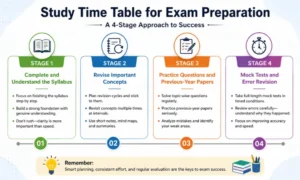
Exam preparation generally moves through four stages, and a timetable should shift emphasis as a student moves through them:
First Stage – Complete and Understand the Syllabus
Early weeks should prioritise finishing new material and building genuine understanding, not speed.
Second Stage – Revise Important Concepts
Once the syllabus is covered, revision cycles should revisit concepts repeatedly rather than reading each topic once and moving on.
Third Stage – Practice Questions and Previous-Year Papers
This is where understanding gets tested against real question formats, which often reveals gaps that re-reading notes never would.
Final Stage – Mock Tests and Error Revision
Full-length mock tests under timed conditions, followed by a close look at what went wrong and why, tend to move a score more in the final weeks than any amount of additional new content. Our guide on realistic NEET preparation strategy goes into this stage in more depth for medical entrance aspirants specifically.
How Many Hours Should Students Study?
There’s no single number that works for every student, and chasing a specific hour count is usually the wrong goal. Two students studying the same six hours can end up in very different places depending on whether that time was focused, distraction-free study or half-attention with a phone nearby. What matters more than the total is whether each session has a clear goal, reasonable focus, and gets followed by actual revision later, rather than treating hours studied as the finish line in itself.
Common Mistakes Students Make While Creating a Timetable
- Packing the schedule too tightly, with no room for delays or off days
- Copying a topper’s or friend’s timetable without adjusting it to personal pace and subjects
- Leaving out breaks, sleep or exercise entirely
- Giving every subject equal time regardless of difficulty
- Planning study sessions but never actually reviewing whether the plan is working
- Treating the timetable as fixed forever instead of adjusting it as exams approach or priorities shift
Conclusion
A well-planned study time table gives structure to a day that would otherwise drift, and the real value sits in consistency, revision, focused sessions and goals that are actually realistic, not in cramming the maximum possible hours into a schedule. There’s no single best timetable for students that works for everyone; the right one depends on class, subjects, learning style, school or coaching hours, and what a student is working toward. Building a schedule around interests, strengths and available time, while still protecting sleep, exercise, meals and downtime, gives study time table students a much better shot at consistency than an ambitious plan that collapses within a week. Small, steady effort kept up over time beats an intense routine that burns out fast, and that’s really what a good timetable is for.
Looking for the best PU College in Mysore where structured timetables and integrated NEET/JEE/CET coaching are already built into the daily routine? Learn more about SVG Centre of Excellence PU College’s programmes.
Frequently Asked Questions
How do I make a timetable for study that I’ll actually follow?
Start with your fixed commitments, school, coaching, travel, and build study blocks around what’s actually left, rather than an idealised full day of study. Keep blocks realistic, protect breaks and sleep, and adjust the plan after a week or two once you see what actually works.
What is the best time table for study, morning or night?
Both can work, and it depends on when a student concentrates best. Some retain difficult subjects better early in the morning when the mind is fresh; others focus better at night once the day’s distractions have settled. Consistency in whichever slot is chosen matters more than which one it is.
How do I create a study timetable for NEET or JEE preparation?
A time table for NEET or JEE preparation generally needs longer daily blocks split across Physics, Chemistry and Biology or Maths, regular revision cycles, and mock tests introduced well before the final stretch rather than only in the last month.
Should the study timetable be the same every day?
Not necessarily. Weekdays with school or coaching look different from weekends, and it’s reasonable to have a weekday version and a lighter or restructured weekend version, as long as both protect revision time and rest.
What should I do if I can’t stick to my study timetable?
Missing a day or falling behind doesn’t mean the whole plan has failed; it usually means the schedule was too ambitious to begin with. Adjust the timetable to something more realistic rather than abandoning the idea of a routine altogether.
About the Author
Chaithra SR is an SEO Executive at OneCity Technologies, Bangalore, with 5.5 years in digital marketing and 2 years of dedicated education-sector experience, having worked on SEO campaigns for PU colleges and schools across coastal Karnataka, including SVG Educational Foundation. LinkedIn: linkedin.com/in/chaithra-sr-4133b0217
Reviewed by L K Monu Borkala, a digital marketing strategist with 20+ years of SEO experience and 650+ client campaigns across India and UAE, overseeing content strategy and editorial compliance at OneCity Technologies. LinkedIn: linkedin.com/in/monuborkala