
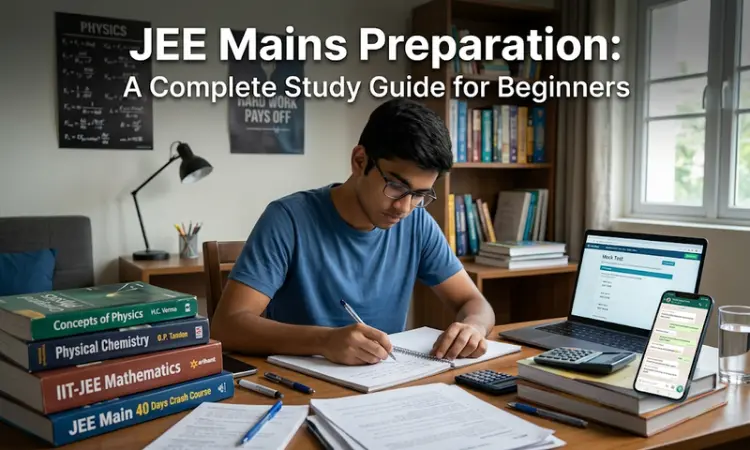
JEE Mains preparation starts with NCERT textbooks for Physics, Chemistry and Mathematics, then moves to reference books for problem practice. The JEE Main exam has 75 questions across three subjects for 300 marks, with +4 for correct and -1 for wrong answers. Build concept clarity in Class 11, practise numerical problems daily, and take at least 15 full-length mock tests before the examination.
JEE Main is the gateway to 31 NITs, 26 IIITs and over 100 other government-funded engineering institutions across India. The National Testing Agency (NTA) conducts the exam twice a year, in January and April, and the better of the two scores counts. Over 12 lakh students register for JEE Main each year, but fewer than 2.5 lakh qualify for JEE Advanced.
For beginners starting in Class 11 or early Class 12, the volume of the JEE main syllabus can feel overwhelming: 28 chapters in Physics, 30 in Chemistry and 16 major topics in Mathematics. A structured JEE main preparation strategy, built on NCERT fundamentals, daily problem practice and regular testing, makes the syllabus manageable and the exam approachable.
JEE Main Exam Pattern, Syllabus and Marking Scheme
Understanding the JEE main exam pattern before starting preparation saves time. Here is the Paper 1 (B.E./B.Tech) structure:
| Detail | Specification |
| Conducting body | National Testing Agency (NTA) |
| Mode | Computer-based (online) |
| Duration | 3 hours |
| Subjects | Physics, Chemistry, Mathematics |
| Questions per subject | 25 (20 MCQs + 5 numerical-value) |
| Total questions | 75 |
| Total marks | 300 (100 per subject) |
| Correct answer | +4 marks |
| Wrong answer (MCQ) | -1 mark |
| Sessions | Session 1 (January) and Session 2 (April); better score counts |
| Scores used for | NITs, IIITs, GFTIs and as eligibility for JEE Advanced (IITs) |
The JEE main syllabus is based on the NCERT Physics, Chemistry and Mathematics textbooks for Class 11 and 12. Physics spans mechanics, thermodynamics, electrodynamics, optics and modern physics. Chemistry splits into physical (numerical), organic (reactions and mechanisms) and inorganic (properties and periodic trends). Mathematics covers algebra, calculus, coordinate geometry, trigonometry, vectors and statistics.
NTA publishes the detailed syllabus on Careers360 and the official NTA website. Download it before starting preparation and use it as a checklist to track which topics are covered.
How to Start JEE Mains Preparation as a Beginner
Beginners often lose the first two months to confusion: too many books, no clear sequence, no daily target. A JEE main study plan that works follows a specific order:
Step 1: Read the NCERT chapter. Not a coaching module. The NCERT textbook for the specific topic. NTA pulls many questions directly from NCERT examples and exercises.
Step 2: Solve all NCERT exercises. Every back-of-chapter question. If the NCERT exercise feels easy, the fundamentals are clear. If not, re-read the chapter before moving to a reference book.
Step 3: Move to one reference book per subject. Solve 20 to 30 problems per topic from the reference book, progressing from easy to hard. Do not collect multiple books: one good reference per subject is enough.
Step 4: Solve previous year questions (PYQs) for that topic. PYQs show what NTA actually tests, which is often different from what coaching modules emphasise.
Step 5: Take a chapter-wise test. 25 questions in 30 minutes, timed, no answer-checking mid-test. Analyse errors within 24 hours.
A daily JEE main study plan for a student attending PU college should allocate two to three hours specifically for JEE preparation, separate from board study time. Morning sessions before college work well for problem-solving; evenings after college suit concept reading and revision.
A practical weekly schedule:
| Day | JEE Focus (2 to 3 hours) | Practice Task |
| Mon | New topic: read NCERT, take notes | 15 MCQs from the same topic |
| Tue | Continue topic: formulas, derivations, worked examples | 15 numericals, easy to hard |
| Wed | Revise last week’s topic | 25-question chapter test (30 min, timed) |
| Thu | New topic: read NCERT, take notes | 15 MCQs from this topic |
| Fri | Continue topic: formulas, reference book problems | 15 numericals |
| Sat | Formula notebook revision, rework errors from the week | Chapter test on Thursday’s topic |
| Sun | Full revision: weak spots from the week | Subject-wise 25-question test (45 min) |
Two subjects covered per week at this pace means the full JEE main syllabus can be completed in 10 to 12 months, leaving three to four months for full-length testing and revision.
Subject-Wise JEE Main Preparation Strategy
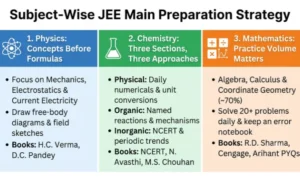
1. Physics: Concepts Before Formulas
Physics in JEE Main tests application, not recall. Start with mechanics (Laws of Motion, Work Energy Power, Rotational Motion) in Class 11 because every other topic builds on it. Electrostatics and Current Electricity in Class 12 are high-weightage chapters.
Draw free-body diagrams before solving any mechanics problem. For electrostatics, sketch the field lines and potential surfaces. For magnetism, trace the direction of force on a current-carrying conductor before plugging numbers into the formula. These visual steps catch errors that formula substitution alone misses.
Recommended: H.C. Verma (Concepts of Physics Vol. 1 and 2) for concept-building; D.C. Pandey for JEE-pattern MCQs.
2. Chemistry: Three Sections, Three Approaches
Physical Chemistry is numerical. Treat it like Mathematics: solve problems daily, build a formula sheet, and practise unit conversions. Thermodynamics, Equilibrium and Electrochemistry carry the most weight.
Organic Chemistry is reaction-based. Learn the named reactions, practise mechanism-drawing, and revise regularly because organic chemistry decays fast without revision. NCERT is sufficient for most organic questions.
Inorganic Chemistry requires memory. Use periodic-table patterns to reduce rote learning. Group properties, coordination compounds and metallurgy from NCERT are frequently tested.
Recommended: NCERT (primary for organic and inorganic); N. Avasthi (Physical Chemistry problems); M.S. Chouhan (Organic for advanced practice).
3. Mathematics: Practice Volume Matters
Mathematics rewards daily practice more than any other subject. Algebra (quadratics, sequences, matrices), Calculus (limits, differentiation, integration) and Coordinate Geometry (straight lines, conic sections) together account for roughly 70% of the Mathematics section. Probability and Statistics, while lower in weightage, often produce formula-based questions that earn quick marks with less preparation time.
Solve at least 20 Maths problems daily. Alternate between easy problems (for speed) and hard problems (for thinking). Maintain an error notebook: for every wrong answer, record which concept was weak, not just the correct solution.
Recommended: R.D. Sharma (basic practice); Cengage Mathematics by G. Tewani (JEE-level problems); Arihant’s Previous Years’ Solved Papers.
Books, Mock Tests and Previous Year Papers
The recommended books above are starting points. The selection principle: NCERT first, one reference book per subject, and NTA’s own question papers. Using more than two sources per subject splits focus and slows progress.
Previous year papers: Solve at least 10 years of JEE Main papers. Start chapter-wise in months 1 to 6. Move to full-length papers in the last 3 to 4 months. The NTA pattern has shifted over the years, so papers from 2020 onward are the most representative.
Mock tests: Take chapter-wise tests after completing each major topic. Take subject-wise tests after finishing each subject’s syllabus. Take full-length JEE main exam pattern tests (75 questions, 3 hours) at least twice a month in the final 3 months. Analyse each test: which questions were wrong, why, and which topics need revision.
Free mock tests are available on NTA’s practice platform and on Motion Education and other coaching sites. Use them, but always analyse the results.
Common Mistakes Beginners Make During JEE Preparation
| Mistake | Why It Hurts | Fix |
| Skipping NCERT | Misses questions that are direct NCERT applications, which NTA includes every year | Read NCERT before any reference book; solve all exercises |
| Too many reference books | Splits focus; no book is finished properly | One book per subject + NCERT + PYQs |
| Ignoring weak subjects | JEE Main needs balanced scores across all three subjects | Give extra time to weak subjects, not less |
| No mock test analysis | Same mistakes repeated across tests | Maintain an error notebook; classify errors by type |
| Starting with JEE Advanced material | Wastes time on difficulty levels that JEE Main does not test | Master JEE Main level first; JEE Advanced follows naturally |
Consistency beats intensity. Two focused hours of problem-solving every day produces better results than a 10-hour weekend session followed by three days of nothing. Track daily targets in a planner or notebook. If a target is missed, adjust the plan rather than abandoning it. The students who clear JEE Main are not the ones who studied the hardest in the last month; they are the ones who studied steadily for 12 months before it.
How Science PU Colleges in Mysore Support JEE Main Preparation
Most Karnataka JEE aspirants prepare for the exam alongside their II PUC board studies. The PU Physics, Chemistry and Mathematics syllabus overlaps with the JEE main syllabus almost entirely. The difference is depth: board exams test recall, JEE tests application.
Science PU colleges in Mysore that run integrated coaching include entrance exam preparation within the regular college schedule. This means the student’s day covers both the PU board syllabus and the JEE syllabus without needing a separate coaching centre after hours. At SVG Centre of Excellence PU College, the Science campus runs CET, NEET and JEE coaching alongside PU board classes. The college offers PCMB and PCMC combinations.
An integrated coaching programme at a PU college provides:
- Faculty who teach both the board syllabus and the JEE syllabus, so students do not need to reconcile two different teaching approaches
- Tests set in the JEE format (+4 for correct, -1 for wrong) after each chapter, giving students early exposure to the exam’s marking pressure
- Weekly progress reports that show which subjects and chapters are below target, so corrections happen during the year rather than during the last month
- A peer group studying for the same exam, which creates the time pressure and competitive focus that solo preparation at home cannot replicate
- Hostel and residential options for students who benefit from a fixed daily schedule with supervised study hours
SVG Educational Foundation (established 2013) operates from Bogadi 2nd Stage, Mysuru, with separate campuses for Science and Commerce. Contact: +91 9482893209 or +91 8884848819.
Conclusion
JEE Mains preparation for beginners comes down to four habits: reading NCERT before anything else, solving problems daily with an error notebook, taking timed mock tests regularly, and analysing every mistake within 24 hours. The exam tests application, not memory, so concept clarity matters more than the number of hours spent studying.
Start with Class 11 topics, build one subject at a time, and track progress weekly. Students who pair disciplined self-study with integrated coaching at a PU college cover both the board syllabus and the JEE syllabus without the overhead of a separate coaching centre.
Planning to Pursue Engineering?
Explore the PU Science courses at SVG Centre of Excellence PU College, Mysuru, and build a strong foundation for JEE preparation alongside your board studies.
Contact: +91 9482893209 | +91 8884848819 | management@svgeducationalfoundation.in
Visit: svgeducationalfoundation.in/puc/
Frequently Asked Questions
How many months of preparation are enough for JEE Main?
Most students begin JEE Mains preparation in Class 11 and prepare over 18 to 24 months alongside their PU board studies. Students who start in Class 12 can still score well with six to eight months of focused preparation if they have strong Class 11 fundamentals. The key is consistency, not the number of months.
Can I crack JEE Main without coaching?
Yes. NCERT textbooks cover the core syllabus, and previous year papers are freely available. Many students combine self-study with integrated coaching at their PU college rather than joining a separate coaching institute. What matters is concept clarity, daily practice and regular mock tests, not whether the coaching happens in a separate building.
What is the difference between JEE Main and JEE Advanced?
JEE Main scores are used for admission to NITs, IIITs and other government-funded technical institutions. JEE Advanced is a separate examination for admission to the IITs, and only students who qualify JEE Main are eligible to appear for it. The syllabus overlaps, but JEE Advanced questions are harder and test deeper conceptual understanding.
Which subjects should I focus on first for JEE Main?
Start with Mathematics and Physics, which together carry 200 of the 300 marks and require the most practice time. Chemistry, especially the inorganic and organic sections, can be covered faster through NCERT and regular revision. Within Physics and Maths, begin with Class 11 topics (mechanics, algebra, trigonometry) since Class 12 topics build on them.
How many mock tests should I take before JEE Main?
Take at least 15 to 20 full-length mock tests before the examination. Begin with subject-wise tests after completing each major topic. Move to full-length tests (all three subjects, 3 hours, 75 questions) at least two months before the exam. Analyse every test within 24 hours of taking it.
About the Author
Vishwanath Sheshachala is the Founder and Chairman of SVG Educational Foundation, dedicated to supporting quality education and creating learning opportunities for students. With a focus on academic growth and student development, he contributes to building an educational environment that encourages learners to achieve their goals.
Reviewed by: L K Monu Borkala, Chief Strategist, OneCity Technologies, a digital marketing strategist with 20+ years of SEO experience and over 650 client campaigns across India and UAE.