

The best study tips for PU students combine a realistic daily timetable, understanding concepts instead of memorising, short personal notes, regular practice with previous question papers, active recall with spaced revision, and consistent sleep and breaks, adapted differently for Science’s numerical and practical work and Commerce’s accounting and theory subjects, rather than one routine for both streams.
PU students juggle Physics practicals, Accountancy problem sets, internal assessments and board exam pressure all at once, often across five or six subjects in parallel. It’s tempting to assume that whoever studies the longest wins. In practice, a student revising four focused hours usually outperforms one who spends eight hours re-reading the same chapter without a plan.
Good PU exam preparation comes down to planning, consistency, genuine understanding rather than memorisation, and regular revision and practice, not raw hours logged at the desk. Science students generally need more time on numericals, diagrams and practical-based questions, while Commerce students need more time on Accountancy calculations, case-based questions and structured theory answers, so a few of the ten tips below are applied a little differently depending on the stream. The ten sections that follow cover the best ways to study across both streams, from timetabling through to revision and health.
Top 10 Best Study Tips Every PU Student Should Follow
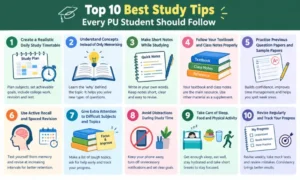
1. Create a Realistic Daily Study Timetable
A daily timetable that actually gets followed matters more than an ambitious one that doesn’t. Divide subjects across the week, giving more time to whichever ones feel harder, and set goals for each block that are achievable in that time rather than aspirational. Build in time for college work, revision and rest, not just new material; a Science student’s week might block longer evening slots for numerical practice, while a Commerce student’s week might set aside more time for Accountancy problem sets. A well-built Best Study Time Table is one of the more effective best study techniques on this list precisely because it makes the other nine easier to actually follow. For the full step-by-step process of building one, including sample weekly schedules, see SVG’s guide to building a study timetable.
2. Understand Concepts Instead of Only Memorising
Memorising a formula or a definition without understanding where it comes from tends to fall apart under exam pressure the moment a question phrases things differently. For Science, that means understanding the reasoning behind formulas, principles, reactions and diagrams, not just their final form. For Commerce, it means understanding why an Accountancy entry works the way it does, or how an Economics concept plays out in practice, not just reciting the definition. When a concept doesn’t click, asking a teacher directly usually saves far more time than re-reading the textbook repeatedly.
Why is conceptual learning important for PU students? Because exam questions are frequently rephrased or applied to a new scenario, and a student who has memorised an answer word-for-word often can’t adapt it, while a student who understands the underlying concept can work through the new version directly.
3. Make Short Notes While Studying
Personal notes, written in a student’s own words rather than copied wholesale from the textbook, are far more useful during final revision than the full chapter would be. Science students can build formula sheets and quick diagrams; Commerce students can build accounting formats, key definitions and short concept summaries. The value is in condensing, not transcribing; copying entire chapters by hand takes real time and produces a second textbook rather than a revision aid.
4. Follow Your Textbook and Class Notes Properly
The prescribed textbook and classroom teaching stay the primary study resource through PU, whatever reference material gets added around them. Paying attention in class and taking usable notes there saves considerable revision time later, and marking anything unclear for a follow-up question keeps small doubts from piling up. Reference books and coaching material work best as a supplement to the syllabus, not a replacement for it.
5. Practise Previous Question Papers and Sample Papers
Regular question practice is what turns “I understand this topic” into “I can answer this topic under exam conditions.” Science students should practise numerical problems, diagrams and application-based questions; Commerce students should practise Accountancy problems, calculations, case-based questions and full theory answers. Reviewing mistakes after every practice session matters as much as the practice itself, since the same error repeated across several papers points to a gap worth fixing directly.
| Study Practice | How It Helps |
| Previous question papers | Understand question patterns |
| Sample papers | Practise different question types |
| Timed tests | Improve time management |
| Mistake review | Identify weak areas |
| Chapter-wise practice | Strengthen individual topics |
6. Use Active Recall and Spaced Revision
Active recall means closing the book and trying to retrieve what was studied from memory, through self-questioning or explaining a concept aloud, rather than re-reading notes passively. Spaced revision means returning to the same topic at increasing intervals, a day later, then a week later, then before the exam, instead of revising it once and moving on. A formula revised this way on day 1, day 4 and day 12 tends to stick far better than one revised three times in a row on day 1 alone. Both work equally well for formulas, definitions, theories and Commerce concepts.
What is active recall for students? It’s the practice of retrieving information from memory without looking at notes, such as answering a question from memory before checking the textbook, rather than simply re-reading material and assuming it has been learned.
7. Give Extra Attention to Difficult Subjects and Topics
Every student has at least one subject or chapter that consistently feels harder than the rest. Keeping an honest running list of these, rather than avoiding them, prevents a difficult topic from turning into a crisis the week before exams. Science students can put additional time into difficult numerical or conceptual topics specifically; Commerce students can focus extra time on the calculations or theoretical areas that keep causing trouble. Asking a teacher for clarification early, and tracking whether a topic is actually improving over time, both matter more here than simply spending more hours on it.
8. Avoid Distractions During Study Time
A phone within reach during a study session interrupts focus even when it never gets picked up, since the anticipation of a notification is itself distracting. Keeping the phone in another room, turning off unnecessary notifications, and studying at a clean, organised desk all reduce that background pull. Setting one clear goal for each study session, rather than a vague plan to “study Chemistry for a while,” also keeps a session from drifting into half-focused multitasking.
9. Take Care of Sleep, Food and Physical Activity
A study routine only holds up if the student behind it is actually rested enough to concentrate. Sufficient sleep, regular meals, proper hydration and short breaks between study blocks all support the kind of sustained focus that late-night cramming works against. A short walk, some stretching, or a quick outdoor game between long study sessions tends to restore concentration better than pushing straight through. Regularly sacrificing sleep to study late into the night is one of the more common ways a good study plan quietly stops working.
10. Revise Regularly and Track Your Progress
Revision that starts only in the final weeks before an exam is revision that’s already running behind. Weekly revision of recently covered material, alongside a chapter-completion checklist marking each topic as Understood, Needs revision or Needs more practice, keeps that from happening. Mock tests, taken periodically rather than only right before the exam, are what actually surface which topics still need work; reviewing the mistakes afterward is what turns that mock test into progress. Many students specifically search for how to study for midterm exams once internal assessments get closer; for a deeper look at applying this tip to that situation, see SVG’s guide to studying for midterm exams.
How often should PU students revise their subjects? Weekly revision of recently covered chapters, combined with a periodic return to older topics, works better for most students than leaving revision until the final stretch. There’s no single number that guarantees high marks; consistency across the term matters more than any specific revision count.
How Science and Commerce Students Can Adapt These Study Tips
The ten tips above apply to every PU student, but the day-to-day version of each one looks a little different depending on the stream. The table below summarises where that difference matters most.
| Study Area | Science Focus | Commerce Focus |
| Concept learning | Formulas, reactions, diagrams, applications | Accountancy logic, Economics and Business Studies concepts |
| Practice | Numerical problems, diagrams, practicals | Accountancy problems, calculations, case-based questions |
| Notes | Formula sheets and diagrams | Accounting formats and definitions |
| Revision focus | Formula and problem-solving recall | Structured theory answers and calculations |
Best study tips for Science students generally mean putting extra weight on numerical practice and diagram-based recall, since a large share of Science marks come from working through problems rather than recalling text. Commerce students tend to get more value from structured theory practice and Accountancy drills, since those subjects reward accuracy and clear presentation as much as raw knowledge. Neither approach replaces the core habits above, timetabling, concept learning, practice, active recall and revision; they simply apply those habits to different material.
Common Study Mistakes PU Students Should Avoid
A few mistakes show up repeatedly among PU students who feel like they’re studying hard but aren’t seeing the marks to match:
- Studying only in the days immediately before an exam
- Memorising answers without understanding the concept behind them
- Ignoring difficult chapters instead of addressing them early
- Skipping numerical or Accountancy practice in favour of reading alone
- Skipping revision entirely once a topic has been “covered” once
- Spending excessive study time distracted by a phone nearby
- Switching between too many reference books or resources at once
- Not asking teachers about doubts until they’ve piled up
- Comparing study hours with classmates instead of tracking personal progress
- Regularly sacrificing sleep for extra late-night study time
Building Study Habits That Actually Hold Up
None of these ten tips depends on studying more hours than everyone else. Planning, understanding concepts, note-making, regular practice, active recall, spaced revision, protecting sleep and tracking progress work together, and they hold up over a full academic year rather than only the week before an exam. A student switching all ten habits on at once usually doesn’t stick with any of them; picking two or three to start with, a realistic timetable and active recall are a reasonable starting pair, and adding the rest gradually tends to work better in practice. Good study tips for PU students, applied consistently through the term rather than crammed into exam week, are what disciplined preparation in Science or Commerce actually looks like.
| Looking for a PU College Built Around Disciplined Study Habits?
SVG Centre of Excellence PU College structures class time, revision and practice around exactly these habits, for both Science and Commerce streams. Call +91 94828 93209, email management@svgeducationalfoundation.in, or explore SVG’s PU programmes. |
Frequently Asked Questions
1. What are the best study tips for PU students to score high marks?
The best study tips for PU students combine a realistic daily timetable, understanding concepts instead of memorising, short personal notes, regular practice with previous question papers, active recall with spaced revision, and enough sleep, food and breaks to sustain consistent study over the full academic year.
2. How many hours should a PU student study every day?
There’s no single correct number; what matters more is that the hours studied are focused, distraction-free and matched to a realistic daily timetable that also protects sleep and breaks. A shorter, well-planned session usually beats a longer, unfocused one.
3. What is the difference between study tips for Science and Commerce PU students?
Science students generally need more time for numerical problems, diagrams, formulas and practical-based questions, while Commerce students need more time for Accountancy calculations, case-based questions and structured theory answers. The core study methods, timetables, concept learning, active recall and revision, apply to both, just applied to different subject material.
4. How often should PU students revise their subjects?
Weekly revision of recently covered chapters, alongside a periodic return to older topics, works better for most PU students than leaving all revision until close to the exams. Exact frequency can flex around a student’s own timetable, but revision spread across the term consistently outperforms revision crammed into the final weeks.
5. What is active recall for students?
Active recall means closing the book and trying to retrieve what was studied from memory, through self-questioning or explaining it aloud, rather than re-reading notes passively. It takes more effort in the moment than re-reading, but builds stronger, longer-lasting retention of formulas, definitions and concepts.
About the Author
Vishwanath Sheshachala is the Founder & Chairman of SVG Educational Foundation, dedicated to supporting quality education and creating better learning opportunities for students. With a focus on academic growth and student development, he contributes to building an educational environment that encourages learners to achieve their goals.
Reviewed By
L K Monu Borkala is Chief Strategist at OneCity Technologies, working on SEO and content strategy across OneCity’s client accounts, including SVG Educational Foundation.