
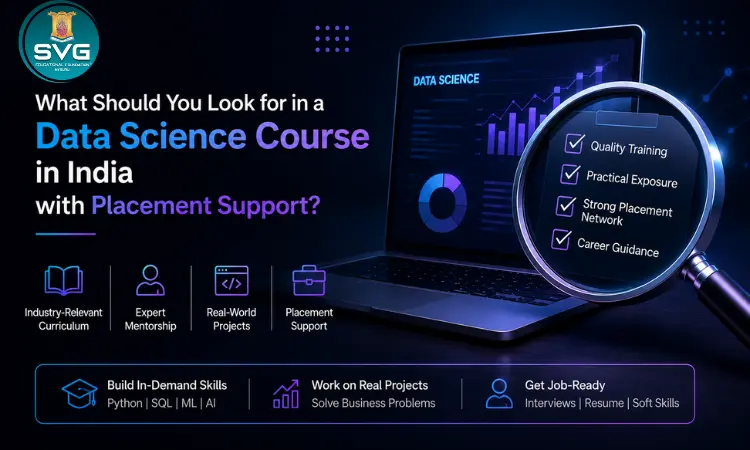
Data Science Course in India must encompass all these qualities skills for a job, practical work, good tutors, and career prospects for you to benefit from it properly.
It needs to take you through the process of learning Python and SQL to applying data science principles for solving business problems and communicating your findings and doing well in interviews. And it is crucial for fresh graduates, working professionals, career changers and even non-technical people because data science recruitment cares about skillset much more than courses completed.
Here is the guide that will help you to assess a course based on these criteria before choosing it.
What matters most?
- Choose a course that teaches Python, SQL, statistics, data analysis, machine learning, and model evaluation.
- Prefer projects based on realistic business problems rather than short, guided classroom exercises.
- Treat placement assistance as career preparation, not a guaranteed job offers.
- Verify instructor experience, alumni outcomes, employer relationships, and published placement terms.
- Select a learning format that provides feedback, doubt resolution, assessments, and mentor access.
- A valuable certification should verify completed learning and practical work.
- Compare programs by outcomes and support quality, not only by duration, discounts, or advertised salary.
- Boston Institute of Analytics presents its Data Science and Artificial Intelligence offering as a 4–10-month program with dedicated career support, hands-on training, real-world projects, and case studies.
What should a data science curriculum include?
A job-oriented data science curriculum must cover the comprehensive workflow from data collection and preparation to analysis, modelling, communication, and deployment.
A useful curriculum normally includes:
- Python programming for data manipulation and automation.
- SQL for querying relational databases.
- Statistics and probability for interpreting patterns and uncertainty.
- Exploratory data analysis and data cleaning.
- Data visualisation using tools such as Tableau, Power BI, Matplotlib, or Seaborn.
- Supervised and unsupervised machine learning.
- Feature engineering and model selection.
- Model evaluation, validation, and error analysis.
- Basics of deep learning and generative AI where relevant.
- Business communication and stakeholder presentation.
- Portfolio development and interview preparation.
The order is important. First, the learner has to comprehend the data, second, he/she builds the model, and third, evaluates whether the model addresses the business challenge. Jumping directly into algorithms may leave learners unable to justify their assumptions and explain the data quality and choices made.
A practical curriculum test
Ask the institute to show the module structure and expected conclusions. Each module should answer three questions:
- What will I learn?
- What will I build?
- How will this skill be assessed?
For instance, “learn regression” is not enough for a machine learning course. What needs to happen here is that the module should demand that you make a dataset, choose the right metric for evaluation, analyze the error and understand the business value of the outcome.
Data analyst will require a better grip on SQL, Excel, dashboard, business reporting, while a software engineer would require more attention to modelling, deployment, API and cloud. Data Science Training in Mumbai, Delhi, Bengaluru, Chennai, Pune, Hyderabad or Thane needs to do this much.
How important are projects in a data science course?

Projects are important because they exhibit whether you can apply concepts without step-by-step instructions.
A credible program must include several projects that cover different data types and business contexts. Useful examples include:
- Customer churn prediction.
- Sales forecasting.
- Fraud detection.
- Recommendation systems.
- Sentiment analysis.
- Marketing campaign analysis.
- Demand forecasting.
- Customer segmentation.
- Document or text classification.
A solid portfolio project requires a problem statement, data dictionary, data cleaning considerations, exploratory data analysis, baseline model, better model, evaluation, limitations, and recommendations for business.
Not all polished notebooks will make for a good portfolio project. An employer might want to know why you used certain metrics, how you dealt with missing data, and how your model would handle new data. You must be ready to answer such questions in your project.
What distinguishes a strong project?
| Project characteristic | Weak implementation | Strong implementation |
| Problem definition | “Predict customer churn” | Defines the business decision and success metric |
| Data preparation | Copies a prepared dataset | Explains missing values, outliers, and leakage risks |
| Modelling | Trains one algorithm | Compares a baseline with alternative approaches |
| Evaluation | Reports accuracy only | Uses metrics suited to the business problem |
| Communication | Shows code and charts | Explains insights to a non-technical stakeholder |
| Portfolio value | Follows a tutorial | Documents decisions, limitations, and next steps |
What should placement support actually include?

Credible placement support should include structured career preparation, employer access, and separate feedback. It should not be presented as an automatic job guarantee if the written terms explicitly define one.
Useful placement support may include:
- Resume and LinkedIn profile reviews.
- Portfolio and GitHub guidance.
- Technical mock interviews.
- SQL, Python, statistics, and machine learning assessments.
- Communication and behavioural interview practice.
- Job-search strategy and application guidance.
- Access to relevant job openings or hiring partners.
- Career counselling based on your background.
- Refresher sessions after course completion.
- Interview feedback and improvement plans.
Boston Institute of Analytics describes its career support as together with resume building, interview preparation, partner access, and live doubt-resolution and refresher meetings.
Placement assistance versus placement guarantee
| Term | What it usually means | What to verify |
| Placement assistance | The institute helps prepare and connect you with opportunities | Number and type of interviews, eligibility conditions, duration of support |
| Placement support | A broader package of mentoring, applications, and interview preparation | Whether support is individual or group-based |
| Placement guarantee | A contractual promise subject to defined conditions | Written policy, exclusions, refund or replacement terms |
| Hiring partner access | Possible access to employer-led events or openings | Whether partners actually recruit learners from the program |
Don’t assume anything from the word “placement.” Request the placement policy in written form. Determine if there are conditions based on attendance, test scores, location options, experience, or assignment completion.
It is also important to know whether the institute publishes the numbers of students enrolled, students graduated, students placed, job title, company name, salary range, and time period. An unverifiable claim like “100% placement” cannot be easily determined without this information.
How should you evaluate instructors and teaching quality?
Choose instructors who can connect technical concepts to production or professional use cases.
Relevant instructor experience may include:
- Building or deploying analytical models.
- Working with real business datasets.
- Managing data pipelines or cloud environments.
- Explaining model outputs to decision-makers.
- Conducting technical interviews.
- Mentoring junior analysts or engineers.
An impressive job title does not guarantee effective education. Attend a demo class if possible. Observe whether the instructor explains assumptions, reviews mistakes, answers questions, and demonstrates practical workflows.
A strong learning environment should provide:
- Live classes or meaningful instructor interaction.
- Recorded sessions for revision.
- Structured assignments.
- Regular assessments.
- Mentor office hours.
- Doubt resolution.
- Feedback on projects.
- Peer or cohort interaction.
Boston Institute of Analytics states that its agendas include live, in-person training, industry-led instruction, real-world projects, and case studies. Prospective learners should still check the exact format, campus, schedule, faculty, and support available for the detailed Data Science program they are considering.
Is a data science certification enough to get a job?
A data science certification can authenticate structured learning, but it rarely replaces applied evidence of ability.
Employers may assess your:
- Ability to write SQL queries.
- Python and data manipulation skills.
- Understanding of statistics.
- Approach to ambiguous problems.
- Model evaluation choices.
- Communication and presentation.
- Understanding of business context.
- Ability to explain your portfolio projects.
When evaluating a Data Science Certification in Delhi or anywhere else, inquire about the nature of the certification. Is the certification a sign of attendance, passing an exam, completion of the capstone, or the achievement of certain competencies?
A more rigorous certification process would involve assessment tests, project evaluations, attendance requirements, and a final review. The value of such certification is further enhanced if the certification has some tangible work behind it and if the information is explained clearly.
The National Qualifications Register is the government register of qualifications based on the National Skills Qualification Framework of India. Nonetheless, the claims made by individual courses must be cross-checked against the list of accreditation.
Which learning format is best?
The best format is the one that gives you consistent practice, feedback, and accountability.
| Format | Best for | Main advantage | Main limitation |
| Classroom | Learners who prefer fixed schedules and direct interaction | Immediate questions and peer learning | Less flexibility and possible travel |
| Live online | Working professionals and learners outside major campuses | Real-time instruction with geographic flexibility | Requires reliable connectivity and self-discipline |
| Self-paced | Highly independent learners | Flexible timing and lower scheduling constraints | Limited feedback and accountability |
| Hybrid | Learners wanting flexibility plus interaction | Combines convenience with mentoring | May require careful schedule management |
Classroom training for Data Science in Mumbai or a Data Science Institute in Bengaluru would be an important factor to consider if you benefit from interacting directly. If you happen to live in Chennai, Hyderabad, Pune, or any other place, online or hybrid learning can provide you with the same benefits if the faculty is accessible and your projects get proper feedback.
How should you compare institutes across India?
Compare institutes using the same evidence checklist instead of comparing marketing language.
| Evaluation factor | Questions to ask |
| Curriculum | Does it cover the full data science workflow? |
| Projects | How many projects are completed independently? |
| Faculty | Do instructors have relevant practical experience? |
| Career support | What services are included and for how long? |
| Outcomes | Are learner results reported with dates and definitions? |
| Certification | What assessment is required? |
| Delivery | Are classes live, recorded, classroom-based, or hybrid? |
| Support | Is mentoring individual, cohort-based, or automated? |
| Cost | What does the fee include? Are there additional charges? |
| Eligibility | What background, attendance, or performance conditions apply? |
A Data Science Program in Chennai should not be judged by location alone. A Data Science Institute in Bengaluru may offer a strong technology ecosystem, but location does not compensate for weak projects or unclear career services. The same principle applies to Data Science Training in Mumbai and a Data Science Certification in Delhi.
How can you verify placement claims before enrolling?
Verify claims using primary documents, not testimonials alone.
Follow this process:
- Request the complete curriculum and schedule.
- Ask for the written placement-support policy.
- Request outcome definitions and the reporting period.
- Review publicly available alumni profiles where possible.
- Attend a demo class or speak with a current learner.
- Ask whether projects are independently assessed.
- Confirm refund, deferment, attendance, and eligibility terms.
- Compare the program with at least two alternatives.
- Calculate the total cost, including tools, exams, travel, and taxes.
- Speak with a career expert before making a payment.
While testimonials reveal individual experiences, they cannot prove typical results. Testimonials and details about their corporate partners, trained individuals, trainers, and job placement services are available on the website of Boston Institute of Analytics. Individuals interested in training should learn to differentiate between individual success stories and audited placement statistics.
Who can benefit from a data science course?
A data science course can suit both technical and non-technical learners, but the preparation required will differ.
- Fresh graduates: Build foundational skills and a project portfolio.
- Working professionals: Add analytics and machine learning to an existing domain.
- Data analysts: Progress toward advanced analytics or machine learning roles.
- Software developers: Move toward machine learning engineering and model deployment.
- Non-technical graduates: Start with mathematics, spreadsheets, SQL, and programming foundations.
- Entrepreneurs and business professionals: Learn to interpret data and make better decisions.
It is not necessary to enter as an advanced coder. It is necessary to have time for practice, numerical literacy, and revision. A programming course that contains foundation modules may be more appropriate than a course tailored only for seasoned engineers.
A practical enrolment checklist
Before joining the best data science course in India with placement support, confirm that you can answer “yes” to most of these questions:
- Is the curriculum mapped to specific job roles?
- Will I complete projects without copying a tutorial?
- Can I meet instructors or mentors regularly?
- Are assignments assessed with written feedback?
- Does career support include mock interviews and portfolio review?
- Are placement terms available in writing?
- Are outcome claims defined by cohort and reporting period?
- Does the course fit my current mathematics and programming level?
- Is the schedule realistic alongside my work or studies?
- Does the fee include all promised services?
- Can I speak with alumni or attend a demo session?
- Does the institute explain what happens if I miss the placement criteria?
The present guidelines by Google regarding generative searches call for valuable, unique and non-commoditized content while stating that standard SEO strategies still form the basis of visibility through AI search options. This concept holds true for the choice of a course as well.
To evaluate the Data Science and Artificial Intelligence course at Boston Institute of Analytics, the best method would be to first examine the current syllabus, its delivery process, on-campus/off-campus nature, eligibility requirements, cost structure and the terms for career support in writing before making an application. The second step should involve discussion with a career advisor about compatibility.
FAQ Section
1. What is the best data science course in India with placement assistance?
The ideal program will have a comprehensive curriculum, independent project evaluations, experienced instructors, and transparent career assistance. Look at written policies, project guidelines, instructor availability, and results rather than using ranking or discounting.
2. Does placement assistance guarantee a data science job?
Career assistance does not mean that you get guaranteed employment opportunities. Usually, it includes resume review, interview simulation, job alerts, mentorship, and employer engagement. Check the institute’s written policy regarding the eligibility criterion, tenure period, and limitations of career assistance.
3. Can a non-technical graduate learn data science?
Non-technical graduates can get into data science through basic courses such as programming, statistics, spreadsheets, and data basics. Learning might be prolonged if the program assumes prior programming or math proficiency.
4. Is a data science certification valuable?
Certification is worthwhile if it evaluates the applicant’s skills and projects done during the program, indicating the learning process. If the certificate only attests to attendance, then it carries no significant weight.
5. How long does a data science course take?
Course duration is mostly dependent on the depth, mode of study, and pace of learning of candidates. According to Boston Institute of Analytics, the Data Science & Artificial Intelligence course can be completed within 4 to 10 months; nevertheless, learners should verify the duration of the specific batch.
6. Should I choose classroom or online data science training?
Select Classroom Training mode if set timings and physical interaction help you learn better. On the other hand, opt for Live Online Training mode if flexibility is of importance to you and real-time mentorship, project evaluation, and doubt clearance is provided by the program.
7. What jobs can follow a data science program?
Some of the career options are data analyst, business analyst, junior data scientist, machine learning analyst, data science associate, and machine learning engineer. The job option is contingent upon your past experience, technical knowledge, portfolio performance, and interview performance.
8. What should I ask before paying course fees?
Request for curriculum, faculty information, project list, evaluation methodology, placement policy, refund policy, total fees, timings, and outcome definition of the particular batch. The above request must be made in writing format.
Final Thoughts
It is a crucial career choice for anyone aspiring to have success in this field. The right Data Science Course in India can make all the difference in getting a job at the end of your training period. Placement support from any Data Science Course in India means much more than just a few certificates; it means gaining knowledge and experience, doing projects that are relevant to the industry, mentoring, interview training, and getting genuine job offers.
While evaluating any institute, one must check the curriculum, expertise of trainers, feedback from students, placement transparency, and kind of career assistance being offered. You need to go for institutes that help you create a good portfolio, enhance your skills and prepare you well for interviews.
However, the ideal combination of these elements can make you get started on your data science career path, but at the same time, it is important to remember that placement support works best when complemented by practice and continuous learning.